
Gas Turbine Bearings: Types, Functions and Maintenance Requirements
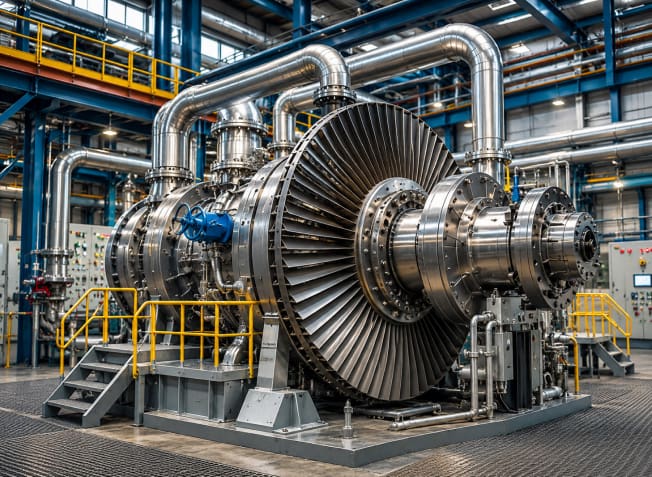
Accurate support of rotating assemblies is needed for reliable and safe operation of gas turbines. This process is highly dependent on bearings supporting the rotor, dealing with the axial and radial stresses and maintaining the required clearances in the turbine assembly. When bearing performance begins to decline, it can cause changes in vibration levels, lubrication, and overall equipment reliability.
A good understanding of Gas turbine bearings, their designs, and maintenance requirements will help power plant operators and maintenance specialists make better judgments. Properly carried out inspections, lubrication management, and timely replacement can all help to extend turbine life and avoid unnecessary equipment damage.
What Are Gas Turbine Bearings and Why Are They Important?
Bearings are mechanical parts that support rotating shafts in gas turbines and enable them to run smoothly in difficult conditions. They help keep the rotors in alignment, and they take the stresses when it’s running.
Bearings are designed to carry radial loads, axial loads,s or a combination of radial and axial loads depending on the turbine architecture.
They are primarily used for:
- Rotor support: Maintaining the correct position of rotating shafts.
- Load management: Accommodating radial and axial forces.
- Friction control: Reducing friction through appropriate lubrication or rolling contact.
- Vibration management: Supporting stable rotor operation.
- Heat management: Helping manage operating temperatures through lubrication and cooling arrangements.
In high-speed turbine applications, the state of the bearings is of paramount importance because mechanical performance can be influenced by small changes in clearances, lubrication, or alignment.
Different Types of Gas Turbine Bearings
Understanding the different Gas Turbine Bearing Types enables maintenance teams to understand working principles and application requirements. Design selection is a function of the turbine manufacturer’s rotor arrangement, speed, loading, and engineering specifications.
1. Journal Bearing
Journal bearings are fluid film bearings. They are widely used for radial load support. A rotating shaft is permitted to run on a bearing surface separated by a thin film of lubricating oil.
When the shaft rotates, es it draws oil into a converging clearance where hydrodynamic pressure is generated to support the load.
The important operating considerations are oil viscosity, bearing clearance, shaft speed, and lubrication temperature. Insufficient oil supply or incorrect clearances can damage the oil film and increase the chances of surface damage.
2. Tilting Pad Bearing
Tilting pad bearings have several pads that can move independently of each other, arranged around a rotating shaft or thrust surface. The pads all shift slightly in position as the shaft runs, and help to form a stable hydrodynamic film of oil.
The bearings are valued for rotor-dynamic stability and ability to cope with demanding operating conditions.
Tilting pad designs are available for journal and thrust bearing applications. They are used according to the design of the turbine.
3. Thrust Bearings
Thrust bearings are used to support the axial loads acting on the turbine shaft. They control the motion of the rotor and its correct axial position.
Tilting pad thrust bearings generally use a number of pads arranged around a thrust collar. The pads are held against the rotating collar by a film of lubricating oil.
Proper axial clearance, load distribution, and lubrication are important for reliable operation.
4. Rolling-Element Bearings
Between the races are rolling element bearings. They have balls or rollers to support rotating components.
Popular designs include:
- Ball bearings: Suitable for applications requiring rotational support with relatively low friction.
- Cylindrical roller bearings: Designed primarily for substantial radial loading.
- Angular contact bearings: Capable of supporting combined radial and axial loads.
- Duplex bearing arrangements: Use paired bearings to accommodate specific combined loading and positioning requirements.
Some designs of aero-derivative turbines incorporate these bearings. Engine architecture and operating requirements determine suitability.
Functions of Industrial Gas Turbine Bearings
Industrial Gas Turbine Bearings contribute to the reliability of power generation and other continuous-duty applications. Their importance extends beyond supporting rotating shafts.
Maintaining rotor stability: Bearings help control shaft movement and maintain the intended rotor position.
Distributing mechanical loads: They accommodate the forces generated during turbine operation and transfer them through the bearing support structure.
Supporting lubrication and cooling: In fluid-film bearing arrangements, circulating oil helps maintain the supporting film and remove heat. Rolling element bearing systems also require appropriate lubrication and thermal management.
Controlling vibration: Correct bearing condition, alignment, and clearances help maintain stable rotating equipment.
Supporting equipment reliability: Proper bearing performance helps reduce the risk of damage to associated turbine components.
These functions are particularly important in power generation facilities where unplanned turbine shutdowns can affect production and operating schedules.
Common Signs and Causes of Gas Turbine Bearing Failure
Bearing deterioration can develop gradually, making regular condition monitoring important.
Some common warning signs include:
- Increased vibration: Changes in vibration levels may indicate bearing deterioration, rotor imbalance, misalignment, or other mechanical problems.
- High operating temperatures: Excessive heat may be associated with lubrication problems, abnormal loading, or increased friction.
- Oil contamination: Water, particles, and metallic debris can indicate lubrication-system contamination or component wear.
- Unusual operating noise: Abnormal sounds may indicate damage, particularly in rolling element bearings.
- Oil pressure or flow changes: Irregular lubrication conditions can affect bearing performance.
- Visible surface damage: Scoring, cracking, discoloration, and excessive wear may indicate deterioration.
Common contributing factors include inadequate lubrication, incorrect bearing clearances, contamination, excessive loading, misalignment, and unsuitable operating conditions.
Importantly, these symptoms do not automatically confirm bearing failure. Vibration readings, oil analysis, operating history, and inspection findings should be evaluated together to identify the underlying cause.
Gas Turbine Bearing Maintenance Requirements
A structured maintenance program helps detect developing problems and ensures reliable turbine operation.
1. Check Temperature & Vibration
Regular monitoring allows maintenance teams to identify changes in the operating conditions of bearings. Current readings are compared to established operating baselines to identify unusual trends.
2. Proper Lubrication
Use the lubricant grade and supply conditions recommended by the manufacturer of the turbine. Lubrication conditions must be appropriate and monitored by oil pressure, temperature, flow, and filtration.
3. Get oil analysis done regularly.
Oil analysis can identify changes in viscosity, water contamination, and abnormal wear particles. Also, by watching the debris,s you can learn useful things about mechanical problems that are developing.
4. Examine bearing surfaces and clearances.
Scheduled inspections should include a check for scoring, cracking, material deterioration, and abnormal wear. Where applicable, check dimensional measurements against manufacturers’ specifications.
5. Check shaft alignment and clearances.
Such misalignment can increase bearing loading and accelerate the rate of degradation. This is especially critical after major maintenance or parts replacement to check alignment and clearance.
6. Keep inspection records
Temperature readings, vibration trends, oil analysis results, inspection findings, and replacement history all contribute to a more complete picture of bearing condition over time.
Predictive Maintenance and Condition Monitoring
Predictive maintenance lets turbine operators assess the condition of equipment rather than relying on fixed maintenance schedules. In bearing systems,s this might include vibration analysis, temperature monitoring, oil analysis, and wear debris detection.
For instance, a gradual increase in vibration and abnormal metallic particles in lubricating oil may lead to a further investigation. It is better to look at a number of indicators together rather than rely on a single reading. This allows maintenance teams to plan inspections, investigate issues as they arise, and minimize the risk of unplanned equipment downtime.
When Is Gas Turbine Bearing Replacement Necessary?
Gas Turbine Bearing Replacement may become necessary when inspections identify excessive wear, cracking, surface damage, or dimensional conditions outside approved limits.
Other possible reasons might be:
- Repeated overheating or lubrication-related damage.
- Persistent abnormal vibration linked to bearing deterioration.
- Damaged raceways, rolling elements, or bearing surfaces.
- Material fatigue or deformation.
- Failure to meet manufacturer serviceability requirements.
Before choosing a replacement, maintenance teams should check the turbine model, bearing identification, part number, dimensions, material requirements,s and relevant technical documentation.
Operators of the GE LM2500, GE LM6000 and PW FT8 turbine platforms need to be particularly aware of identifying model-specific components. Turbine Parts provides turbine component supply and knowledgeable part support for these turbine platforms. Access to the relevant component information enables maintenance professionals to make more informed sourcing decisions.
Factors to Consider When Selecting Replacement Bearings
You can’t just go out and find a bearing with the same description to replace it.
Things to keep in mind:
- Correct identification: Verify the original part number and applicable equipment configuration.
- Technical compatibility: Confirm dimensions, tolerances, load requirements, and material specifications.
- Operating conditions: Consider rotational speed, temperature, lubrication arrangements, and loading.
- Component condition: Review inspection findings and determine whether related components also require attention.
- Documentation: Confirm that the replacement meets applicable OEM requirements and approved maintenance procedures.
Also, the root cause of bearing failure should be investigated. If you change a damaged bearing without fixing the contamination in the lubrication, or without fixing alignment or abnormal loading, you could be right back where you started.
Final Thoughts
Gas turbine bearings are critical for rotor support, load distribution, lubrication, and stable turbine operation. By knowing the different bearing designs, maintenance specialists are able to recognize the individual functions of different bearing designs and identify potential operating problems. Regular vibration monitoring, oil analysis, temperature checks,s and detailed inspections can help detect deterioration before it becomes a major mechanical issue. The identification of the right component and technical compatibility are equally important when a replacement is necessary.
By working with Turbine Parts to obtain reliable component support and plan maintenance well, turbine operators can work toward greater equipment reliability, less downtime, and steady power generation performance.
FAQs
1. What types of bearings are used in gas turbines?
The most common types are journal bearings, tilting pad bearings, thrust bearings,s and rolling element bearings. The turbine is designed based on the turbine architecture, the load requirements, ts and the operating speed.
2. What is the difference between journal bearings and rolling bearings?
The rotating shaft in journal bearings is usually supported on a film of lubricating fluid, which separates the shaft from the bearing surface. Rolling-element bearings support rotating elements between raceways using balls or rollers, which reduces friction.
3. What causes gas turbine bearing failures?
Lack of lubrication, oil contamination, overloading, shaft misalignment, overheating, wrong clearances,s and material fatigue can all be contributing factors.
4. Timely Detection of Problems in Gas Turbine Bearings
Problems can be detected as they happen through vibration analysis, temperature monitoring, oil analysis, and wear debris detection. When combined together, these indicators give a better picture of the bearing condition.
5. When should bearings in a gas turbine be changed?
Inspections may reveal excessive wear, cracking, surface damage, abnormal clearance, or other conditions not within manufacturer specifications and may require replacement. Also find the cause before replacing a part.